Best Age to Start Play School in India: Complete Guide for Parents

Principal & Early Childhood Mentor (14+ Yrs Experience) • Kiddie Clouds Lucknow
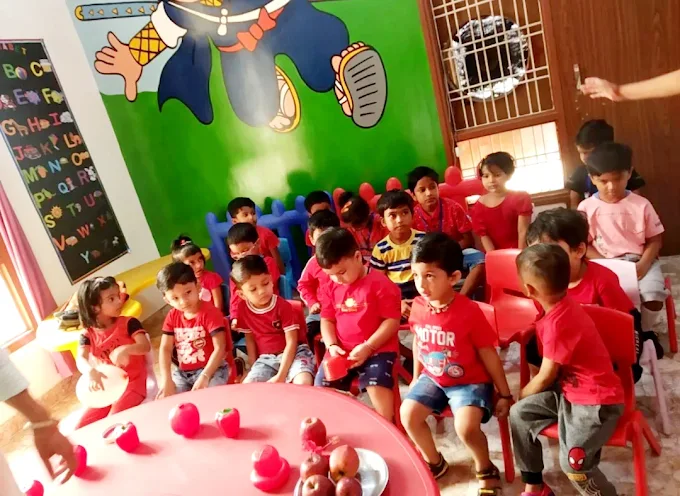
In India, the ideal age to start play school (Playgroup) is between 1.5 and 2.5 years. At this stage, toddlers are eager to explore beyond the home environment, interact with peers, and build communication skills through joyful, play-way sensory activities without any academic pressure.
Key Takeaways at a Glance
- Playgroup is designed for ages 1.5 to 3 years with 2 to 3 hours of gentle daily routine.
- NEP 2020 recommends formal Nursery entry at age 3+, making 1.5–2.5 years the best bridge.
- Play school focuses on speech, sensory play, separation resilience, and peer bonding.
- No formal writing or homework is involved—learning happens through music, clay, and blocks.
Why 1.5 to 2.5 Years is the Sweet Spot for Play School
Between 18 and 30 months of age, children undergo explosive brain development. Their receptive vocabulary expands from single words to short phrases, and their curiosity about other children begins to outgrow the living room.
Starting playgroup at this age does not mean academic schooling. Instead, it offers a predictable, loving setting where toddlers get comfortable being away from parents for 2 to 3 hours a day, overcoming separation anxiety naturally before formal nursery begins.
5 Signs Your 2-Year-Old Child is Ready for Playgroup
Every toddler blooms on their own timeline. Here are 5 everyday behavioral indicators that your child will thrive in a play-way classroom:
- Showing active curiosity when watching other children play at parks or family gatherings.
- Able to express basic needs (hunger, water, washroom, or wanting a toy) through words or clear gestures.
- Can focus on an engaging activity (stacking blocks, coloring, puzzle sorting) for 5–10 minutes.
- Shows willingness to be comforted by familiar adults other than mother and father.
- Energetic and eager to explore tactile textures, music, dance rhymes, and outdoor sand play.
Daily Routine of a Child-Friendly Play School
A scientifically designed play school schedule balances joyful stimulation with calm downtime. At Kiddie Clouds in Manas Vihar Lucknow, the typical 3-hour morning looks like:
• Welcome Circle & Rhyme Time: Greeting peers, singing good morning rhymes, and warm-up stretches.
• Sensory & Montessori Play: Building blocks, kinetic sand, safe playdough, and Speak-o-Kit interactive sound books.
• Nutritious Snack & Table Manners: Washing hands, sitting together with friends, and sharing healthy bites.
• Gross Motor Outdoor Play: Soft slides, ball pool, tricycle riding, and gentle balance beams.
• Storytelling & Wind-down: Illustrated picture books, puppet shows, and joyful parent pickup.
NEP 2020 Guidelines on Preschool Age Structure in India
Under India's National Education Policy (NEP 2020), early childhood care is structured under the 5+3+3+4 foundational framework. Formal foundational learning starts at age 3 in Nursery, followed by LKG (age 4), UKG (age 5), and Grade 1 at age 6.
Therefore, enrolling your 1.5 to 2.5-year-old in Playgroup provides the essential preparatory bridge. It ensures your toddler enters formal Nursery confident, expressive, and completely free from first-day classroom fears.
क्या 2 साल का बच्चा प्ले स्कूल जा सकता है?
हाँ, 2 साल का बच्चा प्ले स्कूल (प्लेग्रुप) के लिए बिल्कुल उपयुक्त होता है। प्ले स्कूल में बच्चों पर पढ़ाई का कोई दबाव नहीं होता। यहाँ केवल 2-3 घंटे खेल-कूद, संगीत, रंग-बिरंगे खिलौनों और दोस्तों के साथ बातचीत के ज़रिए उनका मानसिक और सामाजिक विकास किया जाता है।
Explore Kiddie Clouds Playgroup Program
Designed for toddlers aged 1.5–3 years in Indira Nagar Lucknow. Featuring sensory play, Speak-o-Kit books, gentle caregivers, and 24x7 live CCTV surveillance.
Written by Mrs. Anju Singh
Principal & Early Childhood Mentor • Kiddie Clouds
With a deep passion for early childhood education, Mrs. Anju Singh brings years of dedicated leadership, creativity, and pedagogical care to Kiddie Clouds. She champions positive reinforcement, experiential learning, and inclusive childhood development, ensuring every child feels valued, confident, and joyful.